Please click here to subscribe to our unmissable email Newsletter
You will thank me!!

Freedom, what is it? Is it something we find? Is it something we fight for? It could be, but here we talk about freedom as something we build for ourselves in our own lives everyday.
Please click here to subscribe to our unmissable email Newsletter
You will thank me!!
Have you heard the term shinrin-yoku?
It’s Japanese. It translates, roughly, as forest bathing. And the moment I say that, I can already feel people picturing something they’ve probably done — a long hike, binoculars around the neck, ticking off bird species. That’s not what this is.
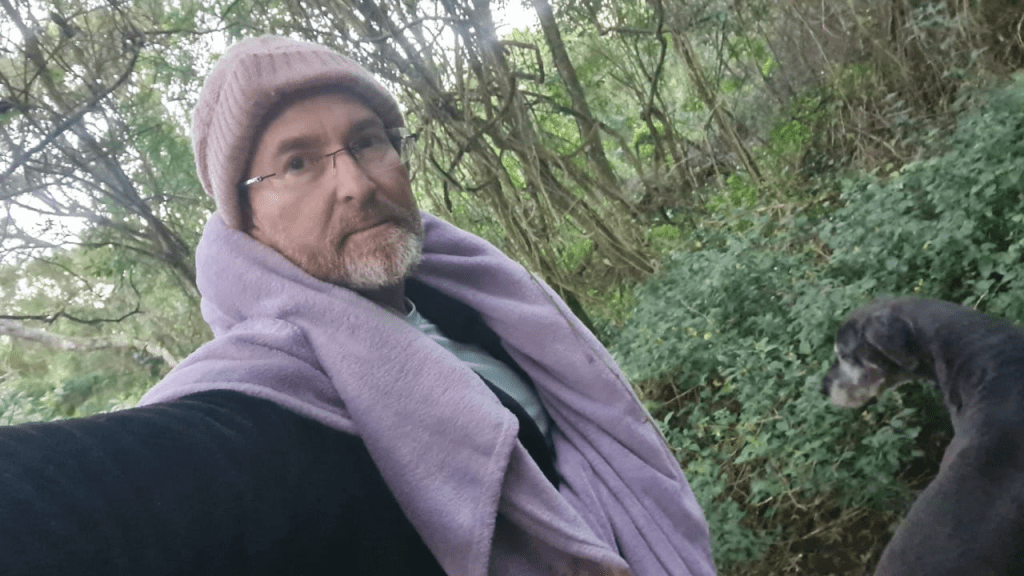
Let me tell you what forest bathing is not, because I think that’s the clearest way in.
It’s not hiking. Hiking is about getting somewhere — covering ground, reaching a summit, experiencing new terrain. I walk the same route almost every morning. The path doesn’t change. What changes, subtly, is everything else. The angle of the light. The quality of the silence. The way the sunrise sits differently on the horizon than it did the day before.
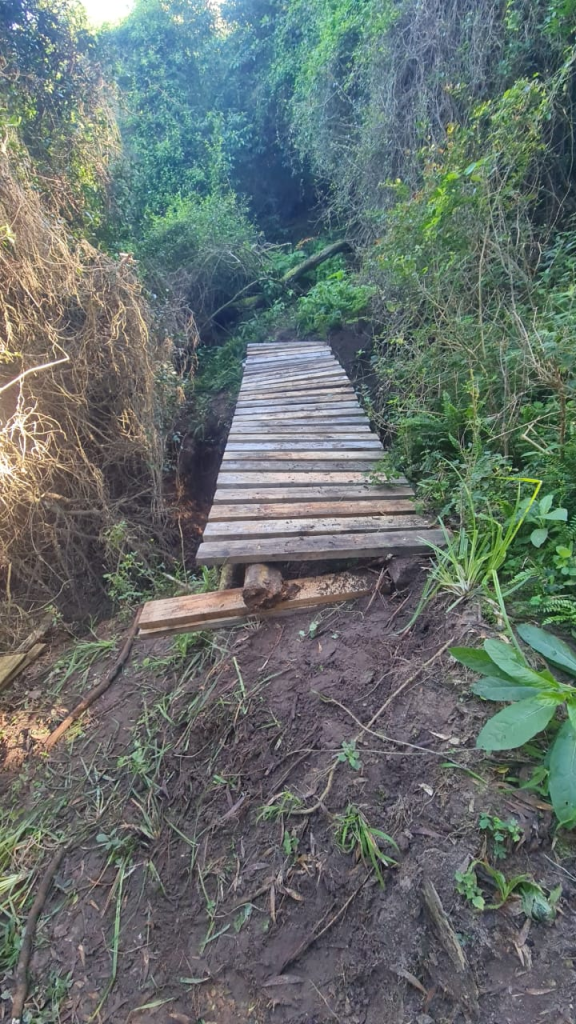
It’s also not naturalism. I’m not cataloguing tree species the way a dendrologist would, or straining to identify birdsong the way an ornithologist might. When I hear a sound in the distance, I try not to name it. I just hear it — and notice, somewhere inside me, what it does.
That’s closer to it. Noticing.
I observe the trees, but not in the way you’d observe something you’re trying to understand. It’s more like appreciating light, or beauty — and then laughing at myself for trying to describe what that even means. I notice the smell of coolness. Does coolness have a smell? I don’t think so. But I try to notice it anyway. I let myself feel something when I come across a tree, or a bug, or a mushroom pushing up through the ground.
And I don’t time myself.
What I also notice — and this is perhaps the most useful part — are the thoughts. The anxieties that surface. Will there be enough money for salaries this month? What does the day in the office hold? They arrive uninvited, as thoughts do. But I try not to fight them. I let them pass the way I let a tree pass through my field of vision as I walk. I don’t beat myself up for having the thought. I just observe it. Ah. There it is.
A Japanese professor — I can never remember his name — didn’t invent this idea. People have walked in forests and felt better for it for as long as there have been forests. What he did was document it. He gathered scientific evidence showing that shinrin-yoku has measurable biophysical benefits — reduced cortisol, lower blood pressure, improved immune function. He made the case so compellingly that health insurers in Japan now cover it when a doctor prescribes a certain number of hours of forest bathing.
That’s remarkable. But here’s the thing: that’s not why I do it.
I don’t walk in the forest because it’s good for me. I don’t think of it as a wellness practice, or a prescription, or something I’m optimising. For me, it’s more like flying a kite. Or swimming in the ocean. Or dancing. You don’t do those things because of the cardiovascular benefits. You do them because they’re beautiful things to do.
The fact that there are health benefits is good. But it’s not the reason.
The reason is simpler than that: it’s a beautiful thing to do.
And some mornings, that’s enough.
A visit to two impressive wineries near Plettenberg Bay raises a question the South African wine industry can’t easily answer.
The conventional wisdom has always been that serious South African wine comes from the Western Cape — Stellenbosch, Franschhoek, the Winelands. But a recent visit to two estates along the Garden Route suggests that geography may be selling the rest of the country short.
Bitou Winery sits near Plettenberg Bay, tucked alongside the Keurbooms River, and it produces a range that would hold its own in far more celebrated wine regions. Their Malbec stands out, as do two excellent Cabernet Francs. The whites and rosés round out a lineup that is, frankly, impressive for a region most South Africans wouldn’t associate with viticulture at all.
These aren’t novelty wines. After tasting them, the verdict is clear: there is nothing wrong with them. They’re very, very good.
Just up the road at The Crags, Bramon Estate takes a more focused approach. The entire estate vineyard is planted to Sauvignon Blanc, from which they produce an MCC (Méthode Cap Classique) and still wines, supplemented by fruit sourced from neighbouring farms. It’s a beautiful property with excellent food and a genuine wine tourism experience — the kind of destination that the Western Cape doesn’t have a monopoly on, whatever anyone might have told you.
Here’s what these two visits make impossible to ignore: if world-class wine can be produced at Plettenberg Bay and The Crags, what exactly is stopping Gqeberha — roughly an hour and a half away and climatically near-identical — from doing the same?
It’s a genuine question, not a rhetorical one. The climate argument doesn’t hold up on its face, because the climate is almost the same. Humidity is often cited as a barrier on the Garden Route, but the vineyards at Bramon offer a clue as to how that challenge is being managed. Walk the rows and you’ll notice the trellising: vines are trained to spread laterally — one wire to the left, one to the right — at roughly one-metre spacing. The effect is to open up the canopy and maximise airflow, reducing the moisture and fungal pressure that humidity brings. Pair that with proper drainage and drip irrigation infrastructure, and the “it’s too wet” objection starts to look less like a hard limit and more like an engineering problem with known solutions.
There may be soil chemistry differences, disease pressure considerations, or economic factors that explain why Gqeberha hasn’t developed a wine industry — but if so, those answers deserve to be heard. The wine-making community watching from a distance might have insights that aren’t widely shared.
In the meantime, one thing is certain: the Garden Route is already producing wines worth seeking out, and the idea that serious wine tourism belongs exclusively to the Western Cape is simply no longer true. The gatekeeping, as it turns out, wasn’t protecting a secret — it was obscuring one.
If you know the answer to the Gqeberha question — whether it’s soil, disease, economics, or something else entirely — the conversation is open. And if you’re anywhere near Plettenberg Bay or The Crags, Bitou Winery and Bramon Estate are both well worth the detour.
Before you boo me off stage, hear me out.
I know there are a lot of people out there — many of you fresh out of university, having been promised a good career — who are looking at artificial intelligence and feeling genuinely anxious. I understand that. But I want to offer a different way of thinking about it, because I believe AI is not your enemy. AI is your friend.
Here’s why.
Technology Has Always Done This
Every significant technology that has come along has done the same thing: it has helped us see more clearly what is truly valuable and what isn’t. That clarity can feel threatening at first, but it has always, ultimately, been liberating.
Think about the ATM. When automated teller machines arrived, the assumption was that banking tellers would become obsolete. And in a narrow sense, yes — you no longer need to queue to draw cash from a person. But what actually happened is that we began to understand how valuable our time with real bankers is when it matters. The ATM freed us up to have more meaningful engagements with the people in the bank for the things that actually require human judgment, human relationship, and human trust.
Technology didn’t destroy the value of the bank. It clarified it.
The Real Thing Always Wins
Here’s another way to think about it. You can watch a rugby match from your couch in high definition, with action replays, close-ups, and expert commentary. It is, in many technical respects, a better experience than being there. And yet people still go out in the cold and the sleet to watch the game live, because they know there is something irreplaceable about being present for the real thing.
The same is true of the Mona Lisa. Technology has allowed us to reproduce that painting with extraordinary accuracy. You can see it in crisp detail on any screen. And yet people save for years, travel to Paris, and stand in long queues at the Louvre just to stand in front of the original — because they know it was painted by Leonardo da Vinci, and that knowledge changes everything. The real thing carries a weight that no reproduction can replicate.
Or consider diamonds. Most people genuinely cannot distinguish a diamond from a cubic zirconia, or even a well-cut piece of glass. And yet people value the real thing deeply, sometimes fiercely. Because authenticity matters. Because knowing something is genuine matters.
What AI Is Actually Teaching Us
AI is going to generate an enormous amount of content. Much of it will be good. Some of it will be indistinguishable from the real thing. And that is precisely what will make us understand, more clearly than ever before, what human creativity, human judgment, human presence, and human authenticity are actually worth.
AI is not going to make your skills worthless. It is going to make the right skills more valuable. It is going to sharpen our collective sense of what matters.
So yes — AI is your friend. Not because it will do your job for you, but because it will help you see, perhaps for the first time with real clarity, what your job actually is.
— Tim Hewitt-Coleman
Director, noh Architects
Gqeberha, Eastern Cape
This piece first appeared in The Herald on 17 February 2026
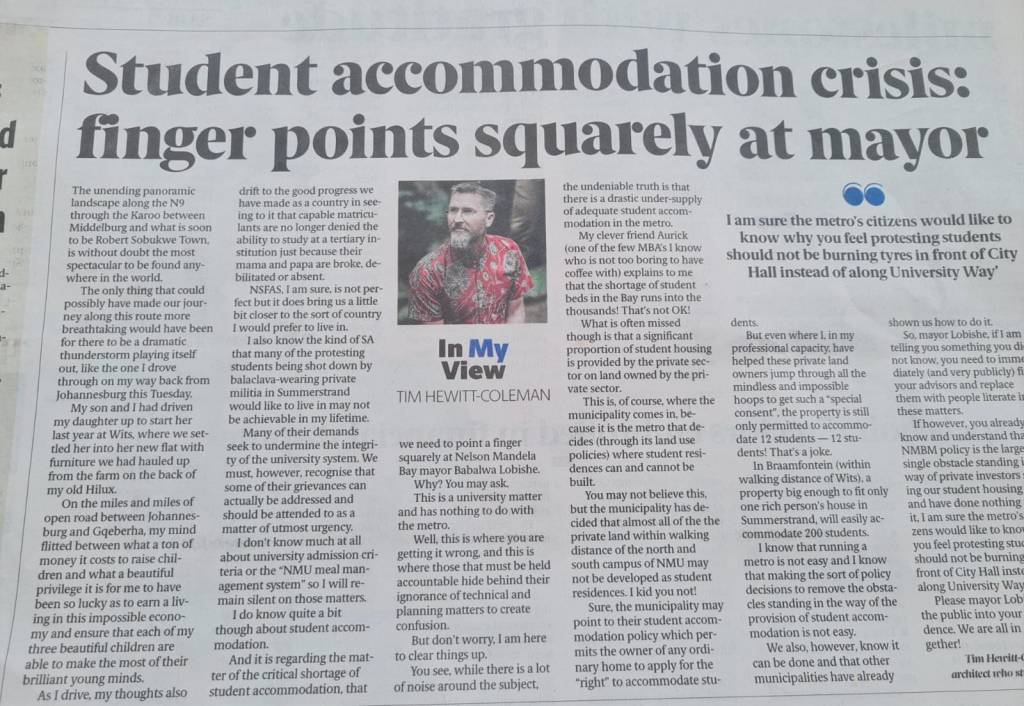
The unending panoramic landscape along the N9 through that part of the Karroo between Middleburg and what is soon to be Robert Sobukwe Town, is without any doubt the most spectacular to be found anywhere in the world. The only thing that could possibly have made this route more breathtaking would have been for there to a dramatic thunderstorm playing itself out, like the one that I was driving through on my way back from Johannesburg this Tuesday. You see my son and I had driven my daughter up to start her last year at Wits where we settled her in to her new flat with furniture we had hauled up from the farm on the back of my old Hilux.
On the miles and miles of open road between Johannesburg and Gqeberha my mind flitted between what a shit ton of money it costs to raise kids and what a beautiful privilege it is for me to have been so lucky as to earn a living in this impossible economy and ensure that each of my three beautiful children are able to make the most of their brilliant young minds.
As I drive, my thoughts also drift to the good progress we have made as a country in seeing to it that capable matriculants are no longer denied the ability to study at a tertiary institution just because their mama and papa are broke, debilitated or absent. NSFAS, I am sure, is not perfect but it does bring us a little bit closer to the kind of country I would prefer to live in.
I also know that the kind of South Africa that many of the protesting students currently being shot down by balaclava wearing private militia in Summerstrand would like to live in may not be achievable in my lifetime. Many of their demands seek to undermine the integrity of the university system. We must however recognise that some of their grievances can actually be addressed and should be attended to as a matter of utmost urgency.

To be honest, I don’t know much at all about university admission criteria or the “NMU Meal Management System” so I will remain silent on those matters. I do know quite a bit though about student accommodation. And it is regarding the matter of the critical shortage of student accommodation, that we need to point a finger squarely at the NMBM Mayor Babalwa Lobishe. Why? You may ask. This is a university matter and nothing to do with the metro. Well, this is where you are getting it wrong and this is where those that must be held accountable hide behind their ignorance of technical and planning matters to create confusion. But don’t worry, I am here to clear things up for everybody.
You see, while there is a lot of noise around the subject, the undeniable truth is that there is a drastic undersupply of adequate student accommodation in the metro. My clever friend Aurick (one of the few MBA’s I know that are not too boring to have coffee with) explains to me that the shortage of student beds in the NMB metro runs into the thousands! That’s not Okay! What is often missed though is that a significant proportion of student housing is provided by the private sector on land owned by the private sector. This is of course where the NMBM comes in, because it is the metro that decides (through its land use policies) where student residences can be built and where they cannot be built. You may not believe this, but the NMBM have decided that almost all of the all of the private land within walking distance of the north and south campus of the NMU may not be developed as student residences. I kid you not! Sure, the NMBM may point to their student accommodation policy which permits the owner of any ordinary home to apply for the “right” to accommodate students. But even where I, in my professional capacity, have helped these private land owners jump through all the mindless and impossible hoops to get such a “special consent”, the property is still only permitted to accommodate 12 students. 12 Students! That’s a joke. In Braamfontein (withing walking distance of Wits), a property big enough to fit only one rich person’s house in Summerstrand, will easily accommodate 200 students.
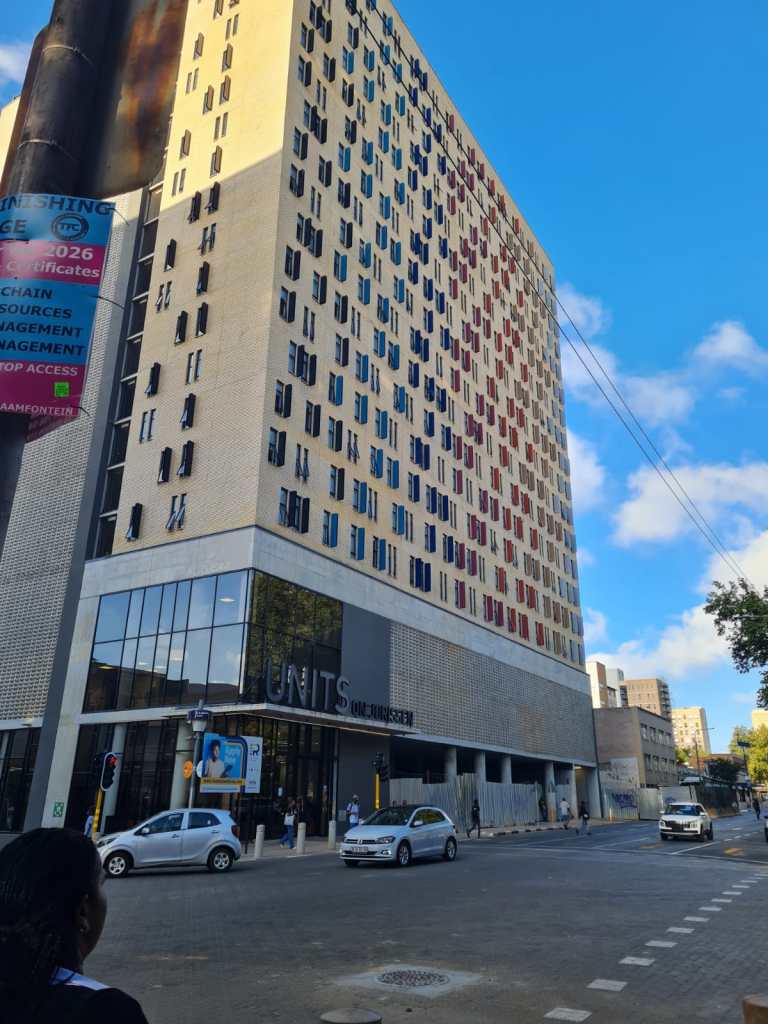
Now I know that running a metro is not easy and I know that making the kind of policy decisions to remove the obstacles standing in the way of the provision of student accommodation is not easy. We also however know that it can be done and that other municipalities have already shown us how to do it. So, to Mayor Lobishe, if I am telling you something you did not know, you need to immediately (and very publicly) fire your advisors and replace them with people literate in these matters. If however, you already know and understand that NMBM policy is the largest single obstacle standing in the way of private investors solving our student housing crisis and have done nothing about it, I am sure the citizens of NMB Metro would like to know why you feel protesting students should not be burning tyres in front of City Hall instead of along University Way. Please Mayor Lobishe, take the public into your confidence. We are all in this together!
Thank you Dean McCleland for this very interesting History of Lake Kragga Kamma and the region.
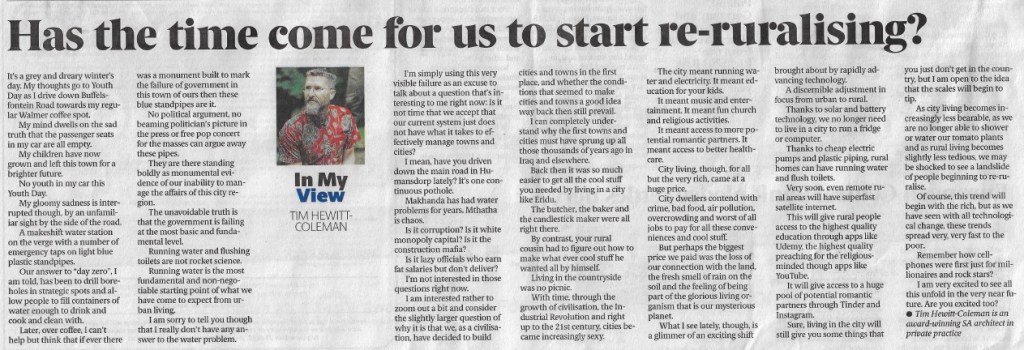
It’s a grey and dreary winter’s day. My thoughts go to Youth Day as I drive down Buffelsfontein road toward my regular Walmer coffee spot. My mind dwells on the sad truth that the passenger seats in my car are all empty. My children have now grown and left this town for a brighter future. No youth in my car this youth day.
My gloomy sadness is interrupted though, by an unfamiliar sight by the side of the road. A makeshift water station on the verge with a number of emergency taps on light blue plastic standpipes. Our answer to “Day Zero,” I am told, has been to drill boreholes in strategic spots and allow people to fill containers of water enough to drink and cook and clean with. Later, over coffee, I can’t help but think, that if ever there was a monument built to mark the failure of government in this town of ours, then these blue standpipes are it. No political argument, no beaming Politian’s picture in the press or free pop concert for the masses can argue away these pipes. They are there standing boldly as monumental evidence of our inability to manage the affairs of this city region. The unavoidable truth is that government is failing at the most basic and fundamental level. Running water and flushing toilets are not rocket science. Running water is the most fundamental and non-negotiable starting point of what we have come to expect from urban living.
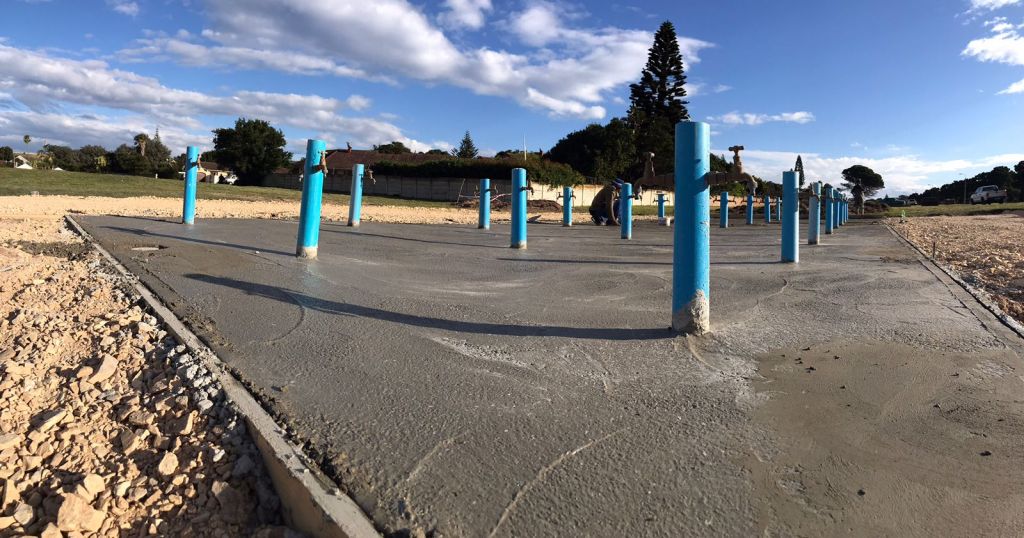
I am sorry to tell you though that I really don’t have any answer to the water problem. I’m simply using this very visible failure as an excuse to talk about a question that’s interesting to me right now:
Is it not time we begin to re-ruralise?
Is it not time that we accept that our current system, just does not have what it takes to effectively manage towns and cities? I mean, have you driven down the main road in Humansdorp lately? It’s one continuous pothole. Makhanda has had water problems for years. Mthata is chaos!!
Is it corruption? Is it white monopoly capital? Is it the construction mafia? Is it lazy officials who earn fat salaries but don’t deliver? I’m not interested in those questions right now. I am interested rather to zoom out a bit and consider the slightly larger question of why it is that we, as a civilisation, have decided to build cities and towns in the first place and whether the conditions that seemed to make cities and towns a good idea way back then, still prevail.
I can completely understand why the first towns and cities must have sprung up all those thousands of years ago in Iraq and elsewhere. Back then it was so much easier to get all the cool stuff you needed by living in a city like Eridu. The butcher, the baker and the candlestick maker were all right there. By contrast, your rural cousin had to figure out how to make what ever cool stuff he wanted all by himself. Living in the countryside was a ball ache!
With time, through the growth of civilisation, the industrial revolution and right up to the 21st century, cities became increasingly sexy. The city meant, running water and electricity. It meant education for your kids. It meant music and entertainment. It meant fun church and religious activities. It meant access to more potential romantic partners. It meant access to better health care. City living though (for all but the very rich) came at a huge price. City dwellers contend with crime, bad food, air pollution, overcrowding and worst of all; jobs to pay for all these conveniences and cool stuff. But perhaps the biggest price we paid was the loss of our connection with the land, the fresh smell of rain on the soil and the feeling of being part of the glorious living organism that is our mysterious planet.
What I see lately though is a glimmer of an exciting shift brought about by rapidly advancing technology. A discernible adjustment in focus from urban to rural. Thanks to solar and battery technology, we no longer need to live in a city to run a fridge or computer. Thanks to cheap electric pumps and plastic piping, rural homes can have running water and flush toilets. Very soon, even remote rural areas will have super-fast satellite internet. This will give rural people access to the highest quality education through apps like Udemy, the highest quality preaching for the religious-mined though apps like YouTube. It will give access to a huge pool of potential romantic partners through Tinder and Instagram. Sure, living in the city will still give you somethings that you just don’t get in the country, but I am open to the idea that the scales will begin to tip. As city living becomes increasingly less bearable, as we are no longer able to shower or water our tomato plant and as rural living becomes slightly less tedious, we make be shocked to see a landslide of people beginning to Re-ruralise. Of course, this trend will begin with the rich, but as we have seen with all technological change, these trends spread very, very fast to the poor. (Remember how cell phones were first just for millionaires and rock stars?)
No they wont. But I have a lot of fun making them : )
For a very long time the general consensus has been that progress equals Urbanisation. While I can see how the past that we come from relied on technologies and conveniences that were just not available to people in the rural areas, I can see now that a shift in technology (and its nudging along by Covid) has helped many of us to beginning to imagine a re-ruralized future.
I really quite enjoyed this piece below that speaks to some of the key drivers in re-ruralisation thinking.
 TimHewitt-Coleman.com